
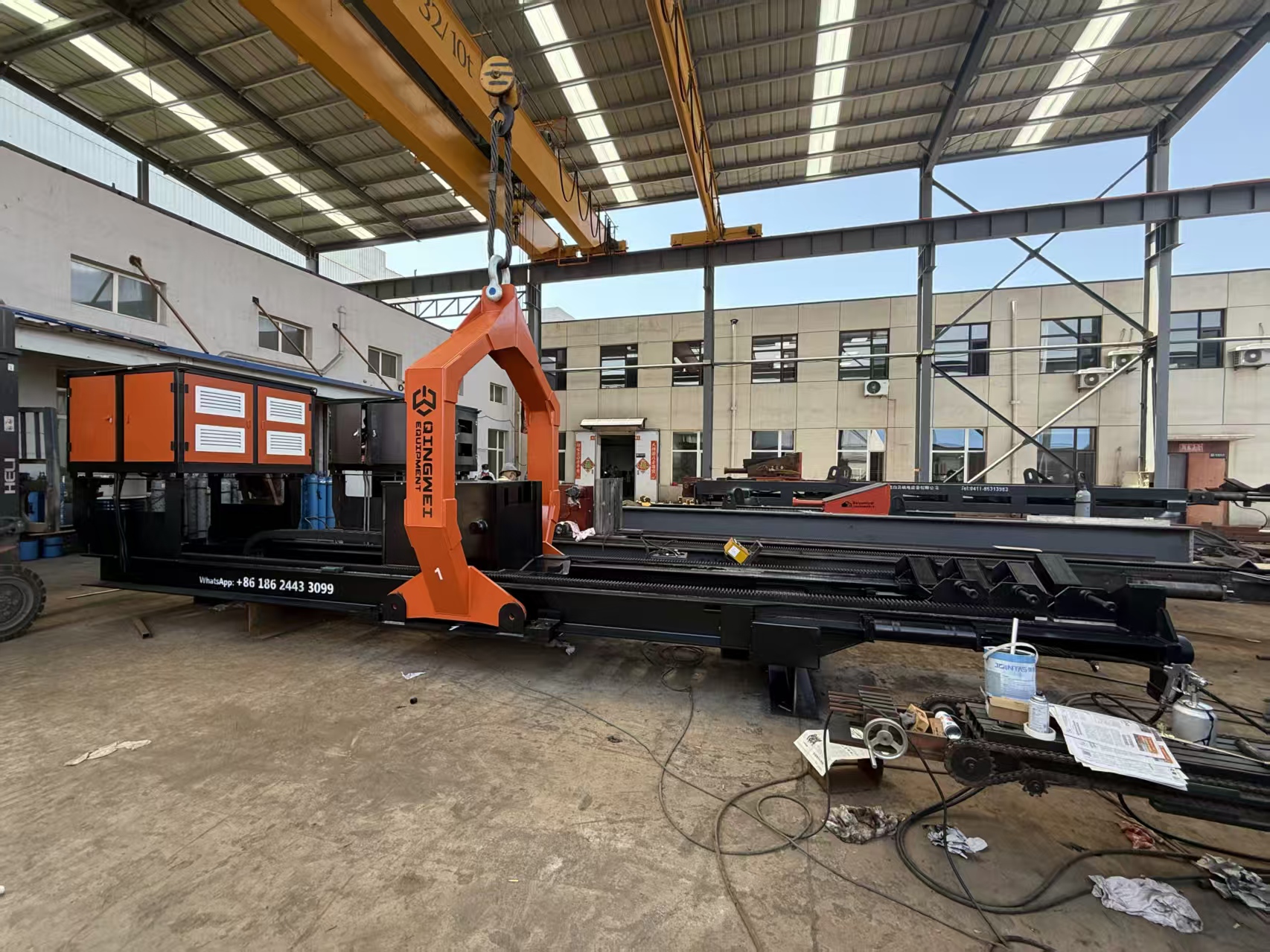
For petrochemical plants, refineries, and industrial maintenance contractors, a diesel tube bundle extractor is often selected for field maintenance projects where independent power, mobility, and practical site adaptability are important.
Compared with workshop-based electric systems, diesel-powered bundle extractors are especially suitable for outdoor turnaround work, remote maintenance areas, and sites where stable industrial electricity is not easy to access. However, choosing the right model requires more than simply comparing rated pulling capacity.
1. Confirm the Tube Bundle Data First
The most important step is to confirm the actual tube bundle information. This determines the suitable pulling capacity, working length, support structure, and overall machine configuration.
- Bundle weight: include possible fouling, residue, retained liquid, and safety margin.
- Bundle length: confirm the total extraction stroke and required machine working length.
- Bundle diameter: affects saddle design, support stability, and clamping arrangement.
- Bundle condition: older exchangers may require higher initial pulling force due to corrosion, fouling, or gasket adhesion.
2. Consider Real Jobsite Conditions
In refinery maintenance, the actual working environment can be more complex than the drawings. The exchanger may be located outdoors, at height, inside a congested structure, or near other equipment and pipelines.
Before selecting the model, check the working height, available access space, crane position, bundle storage area, and whether the extractor needs to be lifted or positioned inside a steel structure.
3. Choose the Right Pulling Capacity
Rated tonnage should be selected with a proper safety margin. A bundle that weighs 20 tons on paper may require a higher pulling force if it has been in service for many years. Corrosion, deposit build-up, and deformation can all increase resistance.
For critical petrochemical projects, selecting a model based only on theoretical bundle weight is not recommended. Stability, guiding accuracy, and hydraulic control should be evaluated together with pulling capacity.
4. Evaluate Diesel Power Configuration
A diesel tube bundle extractor provides independent power and better field flexibility. This is helpful when the site has limited electrical supply, when maintenance work is performed outdoors, or when the equipment needs to be moved between different exchanger positions.
- Suitable for outdoor turnaround and shutdown maintenance.
- No dependence on site electricity during operation.
- Convenient for remote or temporary maintenance areas.
- Good choice when mobility and independent operation are priorities.
5. Pay Attention to Stability and Bundle Support
During extraction, the tube bundle must be supported in a stable and controlled way. The machine frame, saddle structure, hydraulic system, locking arrangement, and guide system all affect safety and efficiency.
A well-designed extractor should reduce bundle slipping, keep the load stable during pulling, and allow the operator to control movement smoothly during both extraction and reinsertion.
6. Check Service, Training, and Spare Parts Support
For petrochemical plants and maintenance contractors, after-sales support is part of the real value of the equipment. Operator training, maintenance guidance, troubleshooting support, and spare parts availability should be considered before purchase.
For international projects, it is also helpful to confirm the required documentation, packing plan, shipping arrangement, and installation guidance in advance.
Conclusion
Choosing the right diesel tube bundle extractor requires a full review of bundle dimensions, bundle weight, site access, working height, lifting conditions, and project schedule. The best model is not only strong enough, but also stable, controllable, and practical for the actual jobsite.
If you are preparing a refinery or petrochemical maintenance project, Qingwei Equipment can help review your bundle data and recommend a suitable diesel-powered bundle extractor configuration.